AI-built courses
Name a topic. Get a whole course built for it.
Learnscape generates a complete course for the one topic you name: narrated video lessons and explorable simulations you can walk through, not a stack of generic slides.
What you get
Every course contains video lectures, simulations and even games that help you master the topic you're interested in.
Narrated video lessons
Every lesson is a real video, rendered at full quality and narrated in a natural speaking voice rather than a robotic reader. 9 of them per course.
Explorable simulations, in two kinds
Each module gets the kind that suits it. A process becomes a small isometric world, in the SimCity / RollerCoaster Tycoon / Factorio vein, that runs the mechanism while you watch. A calculation becomes a live diagram in the vein of Transformer Explainer: type your own input, follow it through every step, open any box to see its real numbers, and drag the sliders to run it again.
A syllabus with a fidelity ledger
A written outline of the whole course, plus something most generated content doesn't give you: a plain statement of which numbers in the simulation are genuinely computed, which are scaled for clarity, and which are reasonable assumptions.
Examples
This is what an explorable looks like
These four were built by hand, not by the generator. They are the reference works it is modelled on: three worlds that run a whole system, and one live diagram of a calculation. Every course module gets one of those two kinds.
TokenTown
How an LLM works, as a city
Every district is one stage of a transformer. A convoy carries the hidden state from the docks where text is cut into tokens, through the foundry that casts it into a vector, around the layer ring once per block, to the sampler that gambles it into the next word.
The temperature and top-p sliders drive the real sampler: turn them and the numbers move.
Open the live explorable(opens in a new tab)ChipTycoon
How a computer chip is made
An isometric theme park that is really a fab. One cart carries a single wafer through twenty buildings, and its cargo changes at every stop: a heap of sand, rough silicon, a silver crystal, a mirror-flat disc, a patterned one, a tray of finished chips.
Twenty stops, each pausing long enough to read, then the lorry runs it out to the data centre.
Open the live explorable(opens in a new tab)EUV Lithography
How 13.5 nm light prints a chip
The same idea in a different costume: an ASML machine laid out as a production and operation manual. Tin-plasma source, illuminator, projection optics, wafer stage, with a factory trainer where you route the parts yourself.
It states outright that it is a teaching model and its values are rounded, rather than implying precision it doesn't have.
Open the live explorable(opens in a new tab)NextWord
A tiny language model, with its insides showing
The other kind of explorable: the calculation itself, drawn as one diagram. Type a few words and a small, real transformer turns them into a guess for the next one, with every box holding the numbers it actually computed, from embeddings through two attention heads to the final odds.
Hover a word to follow it through every step, open any box for its numbers, and drag temperature and top-k to re-run it.
Open the live explorable(opens in a new tab)
Made by Learnscape
Courses the generator built, shown as they came out
Unlike the examples above, these were produced by the generator from a one-line topic. Where a person changed anything, the course says exactly what. Both are smaller than a course you order: 1 module of 4 lessons, where yours has 3 modules of 3.
Lean course · 1 module · 4 narrated lessons · 1 explorable
How Large Language Models Work
Peek inside the machine that predicts your next word, one token at a time.
Topic typed in: “How large language models work”
 The Prediction WorkshopType a sentence and a cart carries its tokens through a small transformer you can watch: a tokenizer bench, an embedding floor, an attention loom and a prediction counter, with a temperature dial that changes the real softmax.Open the live explorable (opens in a new tab)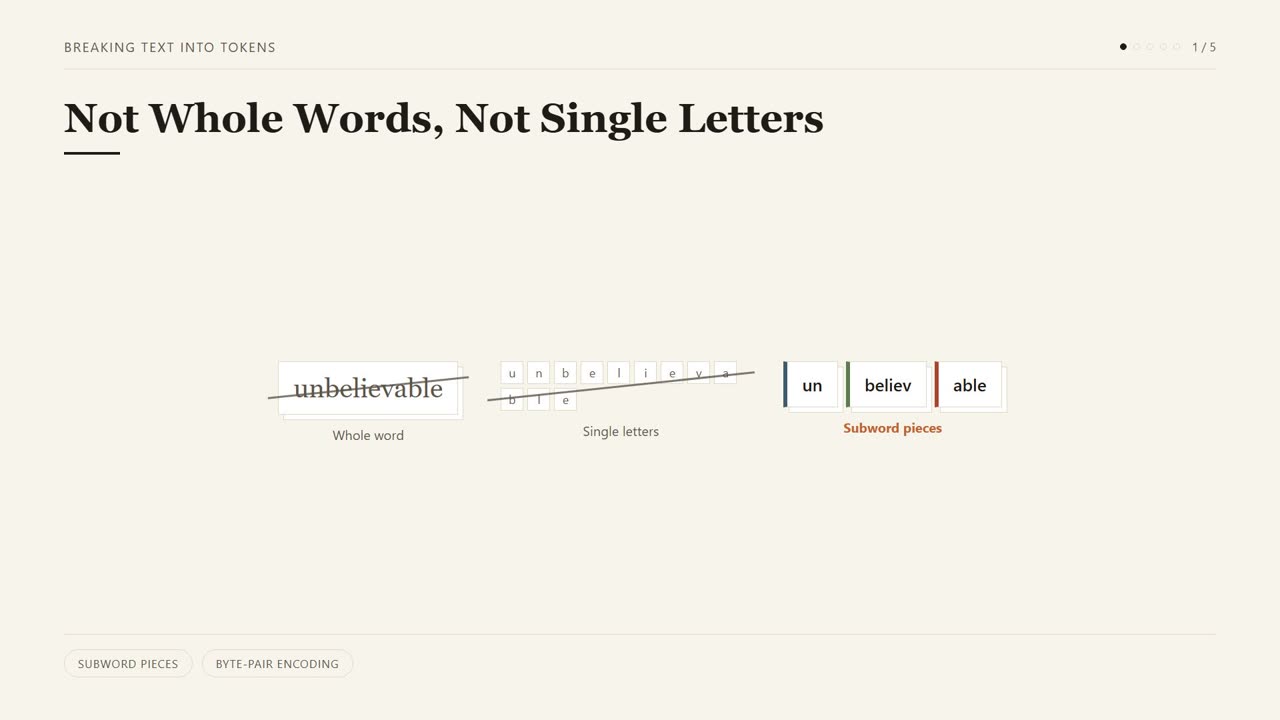
1. Breaking Text into Tokens
2:19 narrated video
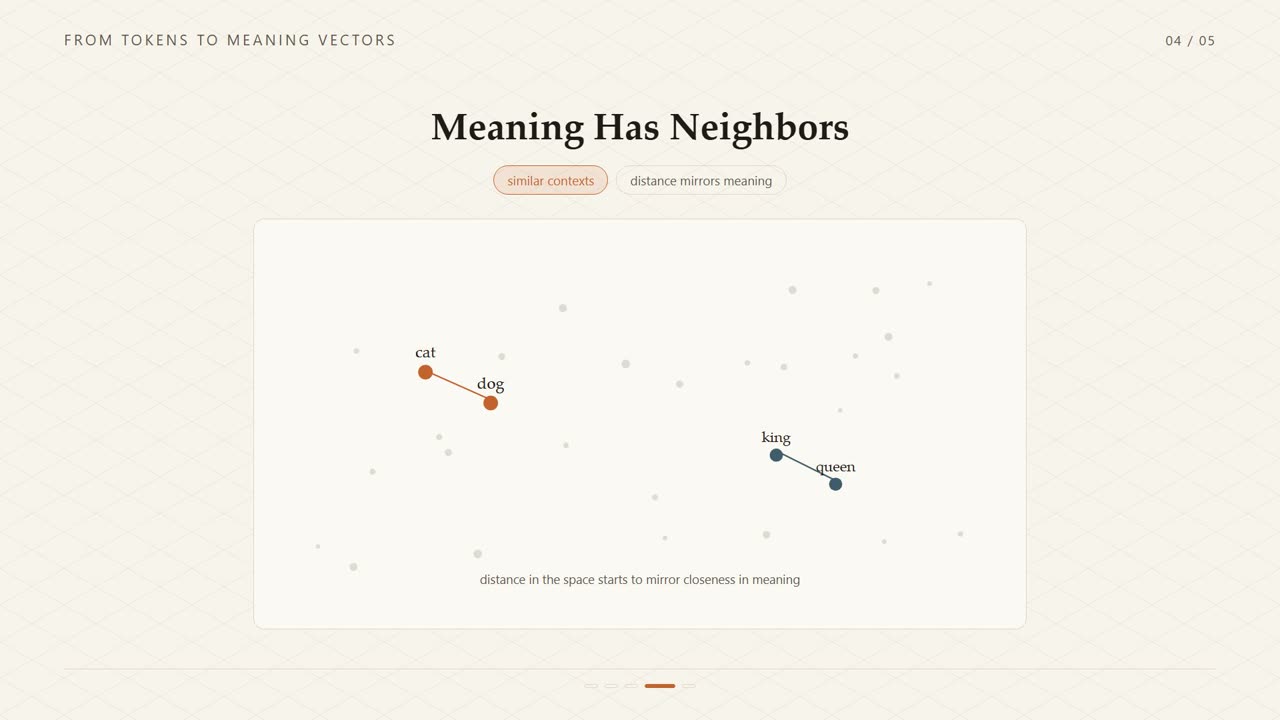
2. From Tokens to Meaning Vectors
2:01 narrated video
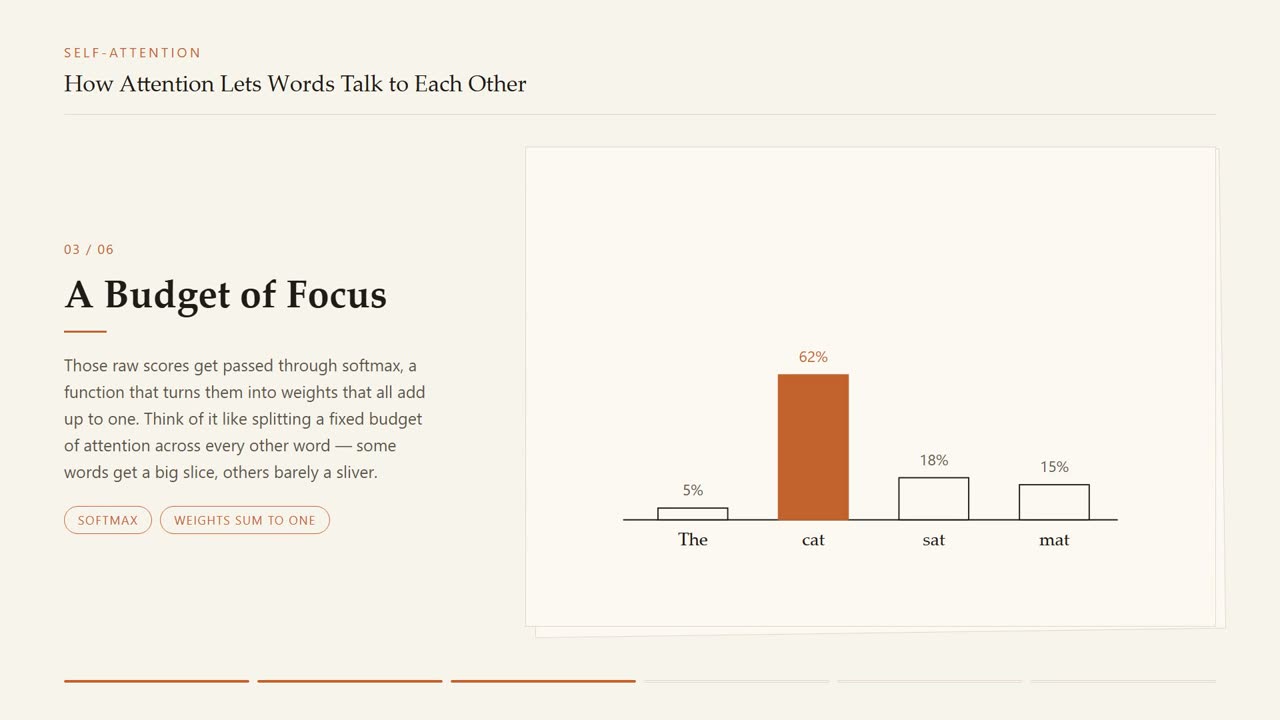
3. How Attention Lets Words Talk to Each Other
2:08 narrated video
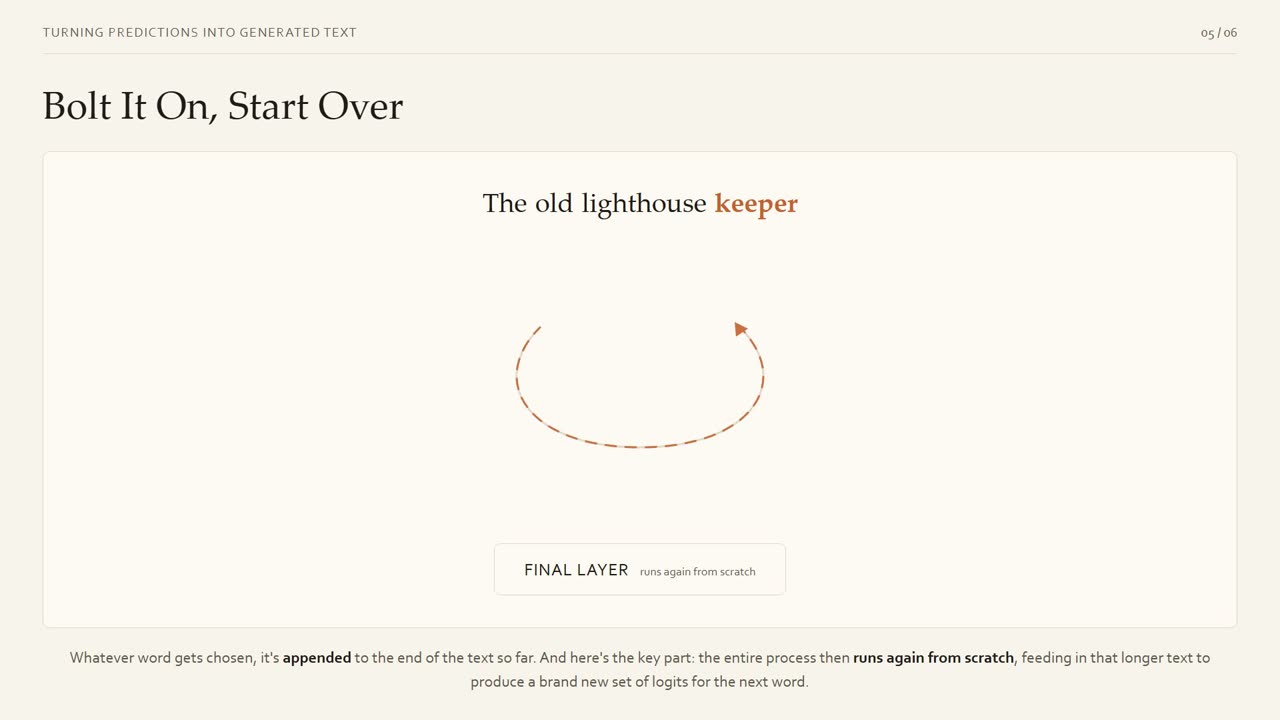
4. Turning Predictions into Generated Text
2:21 narrated video
What is real in the simulation
- 9 computed
- 5 scaled
- 3 assumed
- 1 faked
Tokenizing, attention, softmax and sampling are computed live in the page. The 48-word vocabulary and every weight are invented for teaching, and the ledger admits outright that the predicted words are not meant to make sense.
Changed by hand
- The brief for the simulation first asked for a real transformer's vocabulary and weights, which a static page cannot honestly contain. It was rewritten by hand to ask for a small teaching model, and the generator built the simulation from that brief.
Lean course · 1 module · 4 narrated lessons · 1 exploded view · 1 explorable
How a Four-Stroke Car Engine Works
Watch a single cylinder breathe, compress, fire, and exhaust to see how cars turn fuel into motion.
Topic typed in: “How a four-stroke car engine works”
 Cylinder OneA cutaway of a single cylinder that actually runs. The piston, valves and spark follow real crank geometry, and the pressure, torque and power readouts are worked out as it turns. Mistune the throttle or the spark advance and watch it run weak, knock or stall.Open the live explorable (opens in a new tab)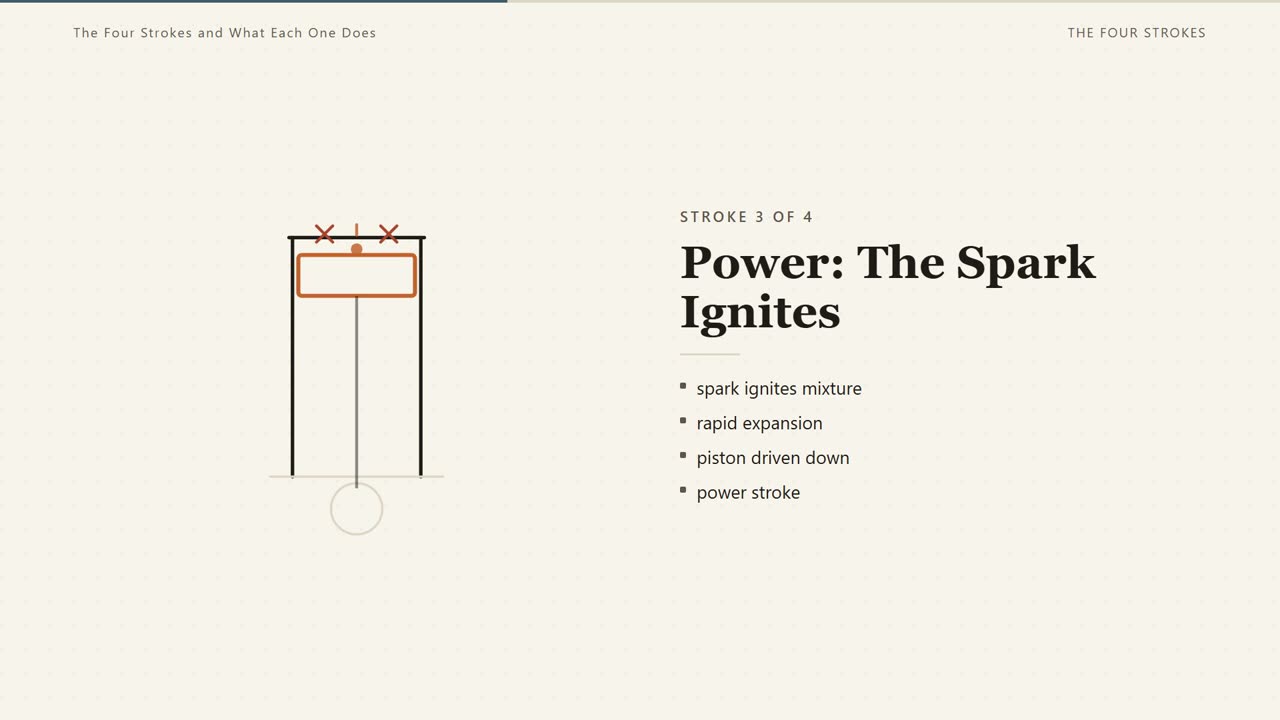
1. The Four Strokes and What Each One Does
1:56 narrated video
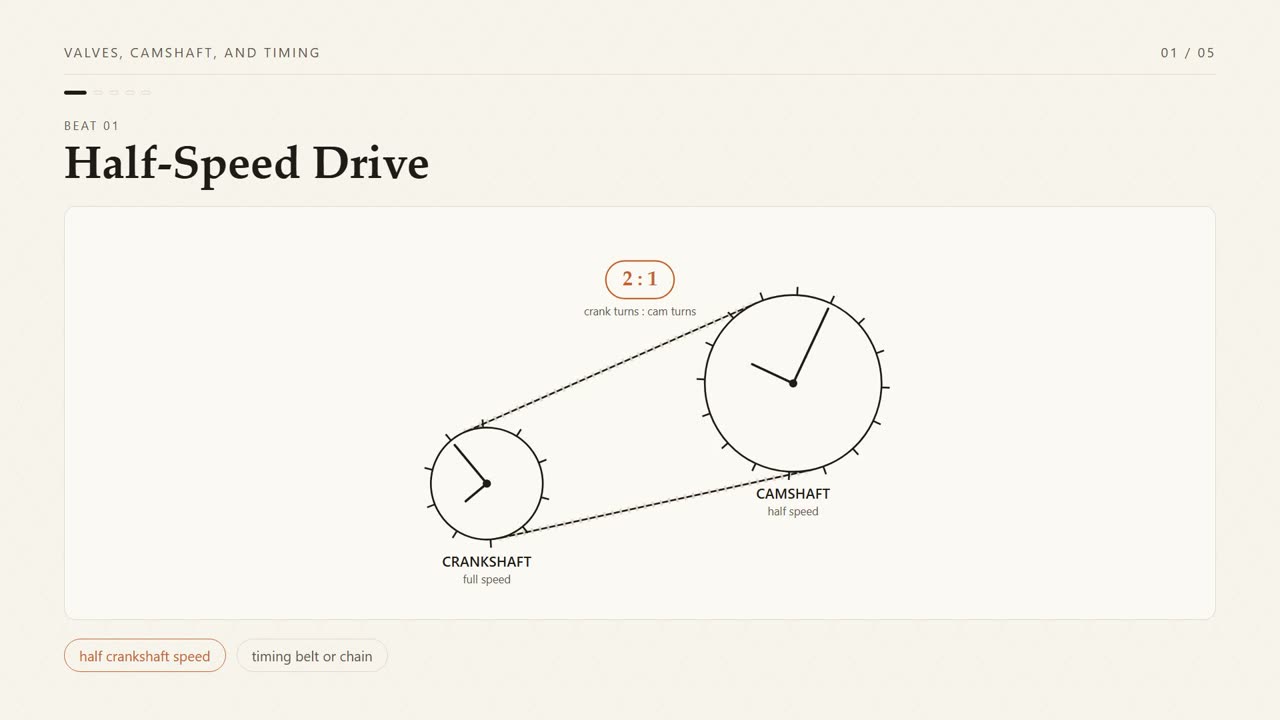
2. Valves, Camshaft, and Timing
2:15 narrated video
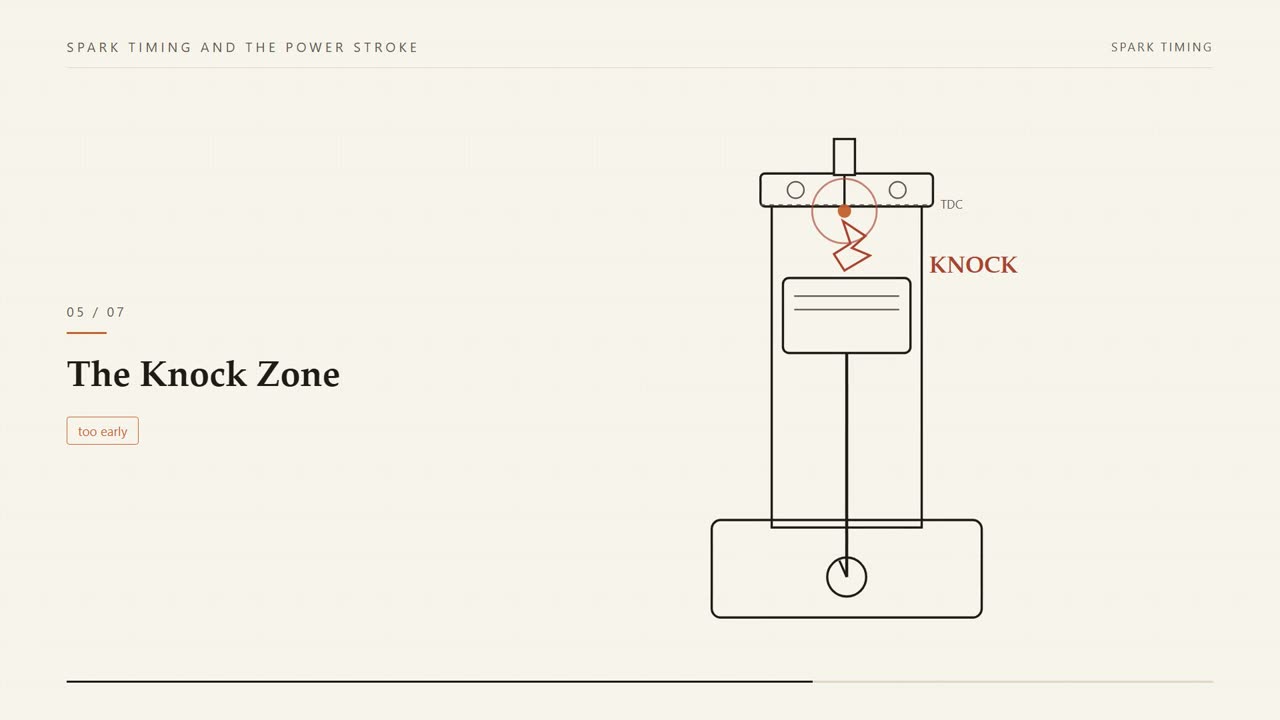
3. Spark Timing and the Power Stroke
2:11 narrated video
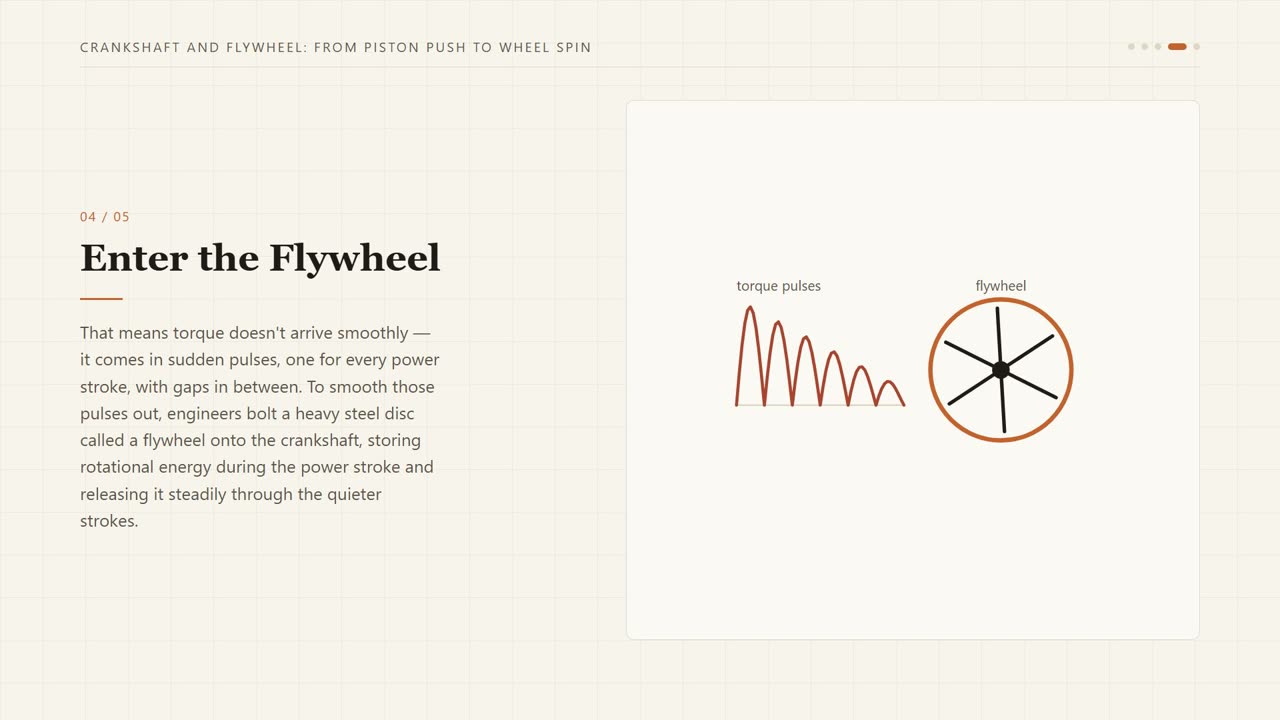
4. Crankshaft and Flywheel: From Piston Push to Wheel Spin
2:07 narrated video
Taken apart
Four-stroke engine cylinder assembly (single-cylinder testbed)
Drag the slider to pull it apart, and select any part to read what it does. The parts outlined in dashes are drawn see-through so nothing behind them is hidden.
Order follows an actual teardown: unscrew the spark plug, lift the camshaft and both valves out of the head, unbolt the head from the block, draw the piston up out of the bore, slide the ring pack off it and drive out the wrist pin, then drop the connecting rod and finally the crankshaft out of the crankcase — leaving the block as the one part that never moves.
Select a part, in the drawing or in the list, to read what it does.
What is real in this drawing
- 3 scaled
- 2 assumed
- 1 faked
The parts, their order and what each one does are the substance. Proportions are a typical engine rather than a measured one, and the distances parts travel as it opens are chosen for legibility, which the ledger marks as faked.
What is real in the simulation
- 7 computed
- 1 scaled
- 8 assumed
- 2 faked
Piston position, valve lift, cylinder pressure and temperature, work, torque and engine speed are computed live. The gas properties, the combustion curve and the friction are textbook assumptions, and the knock warning is a teaching signal rather than real knock detection, which the ledger marks as faked.
Changed by hand
- Nothing in the content. The simulation's builder ran out of steps while re-checking a build it had already finished. That build passed the same automated checks every simulation must pass and was published unchanged, without the builder's own test screenshots.
How it works
Four steps, about 3 hours
Honestly, that's how long it takes to write, voice and render 9 videos and build and test 3 simulations. You can close the tab; it keeps going, and your dashboard shows each stage as it finishes.
- 01
Name your topic
Orbital mechanics, sourdough fermentation, the 2008 financial crisis. Anything at all.
- 02
A syllabus is designed
3 modules, 3 lessons each, with objectives and a concept for each simulation.
- 03
Lessons are written, voiced and rendered
Scripts become narration, narration becomes audio, and the video and simulation are built and checked.
- 04
Your course appears in your library
Videos, simulations and the syllabus, ready to open. Yours to keep.
What a course contains
3 modules, 3 lessons each
9
narrated video lessons
3
explorable simulations
Module 1
- Lesson 1 · narrated video
- Lesson 2 · narrated video
- Lesson 3 · narrated video
- 1 explorable simulation
Module 2
- Lesson 1 · narrated video
- Lesson 2 · narrated video
- Lesson 3 · narrated video
- 1 explorable simulation
Module 3
- Lesson 1 · narrated video
- Lesson 2 · narrated video
- Lesson 3 · narrated video
- 1 explorable simulation
Pricing
Two ways to pay, no surprise charges
Monthly
Most flexibleFor people learning something new every week.
5 course credits every billing period.
Unused credits reset at the end of the billing period. They do not carry over.
- 5 full courses every month
- Narrated video lessons for every topic
- An explorable simulation per module
- Keep everything you have generated
- Cancel any time
Single course
One topic, one course, no subscription.
1 course credit included.
This credit never expires.
- 1 full course
- Narrated video lessons
- An explorable simulation per module
- Yours forever: the credit never expires
Full plan details on the pricing page.
Questions
Frequently asked
What topics work best?
Anything with real structure or mechanism underneath it: a system with moving parts, a process, a historical sequence, a scientific principle. If you can imagine a diagram of it, the simulation builder can probably build a working version of that diagram.
What happens if generation fails?
The pipeline verifies its own output at every stage: a video has to actually render, a simulation has to actually load and run with no console errors. If a course still can't be produced after retrying, it's marked failed and the credit that paid for it is refunded to your account automatically. You are never charged for a course you don't get.
Do I keep my courses?
Yes. Once a course is generated it's yours. It stays in your library whether or not you keep subscribing, and a lapsed subscription never removes what you've already built.
Can I download them?
Yes. Every lesson video and the syllabus are downloadable from your library, so you can keep a copy outside Learnscape.